
Understand your AI. Make decisions you can explain.
An AI evaluation workspace for teams building or buying AI. Connect data checks, model tests, risks and evidence—from the first evaluation to the next review.
Is this AI suitable for the way you’ll use it?
Start with the intended use and what would count as an acceptable result. Complete data can still contain invalid values; a model’s performance can change with its inputs. Follow the checks through to the decision.
Start with what goes in.
Missing values are only one concern. Check validity, consistency and leakage before trusting model results. Select a dimension to inspect the data profile.
- Data Integrity: 88/100
- Completeness: 91/100
- Validity: 28/100
- Consistency: 22/100
- Uniqueness: 84/100
- Representativeness: 76/100
- Leakage Risk: 90/100
- Redundancy: 82/100
Data Integrity · 88/100 · Pass
Change the conditions. Examine the difference.
Establish a baseline, change the conditions, and compare results across groups. Keep the predictions so you can score them again without rerunning inference.
Does it work on the data you actually use?
Establish how the model performs before you introduce harder conditions.
Original input
Baseline test
What changes when conditions get harder?
Compare the same visual input with a simulated fog layer.
Original input
Simulated fog
Does the average hide a difference?
Separate the evaluation data into groups, then compare their results.
Group A
Group B
What is the model relying on?
Compare the original input with a masked region to investigate its influence.
Original input
Region masked
Give each finding a next step.
Connect a finding to the risk it raises, the measure addressing it and the person responsible. Keep the supporting evidence with that response.
No owner assigned to AI management
Level: High · Inherent
Finding
Record the affected groups and the test that exposed the difference.
Action
Name an owner, document the response, and agree when to test again.
Evidence
Link the test results and source records, so the decision can be reviewed later.
Fairness changes across groups
Level: Medium · Mitigated
Finding
Record the affected groups and the test that exposed the difference.
Action
Name an owner, document the response, and agree when to test again.
Evidence
Link the test results and source records, so the decision can be reviewed later.
Missing evaluation records
Level: Medium · Residual
Finding
Record the affected groups and the test that exposed the difference.
Action
Name an owner, document the response, and agree when to test again.
Evidence
Link the test results and source records, so the decision can be reviewed later.
Sensitive to corrupted data
Level: Low · Mitigated
Finding
Record the affected groups and the test that exposed the difference.
Action
Name an owner, document the response, and agree when to test again.
Evidence
Link the test results and source records, so the decision can be reviewed later.
Make the decision reviewable.
Bring the intended use, risks, controls and reviewed evidence into an Assessment. Record the decision with its conditions and remaining gaps.
Keep the reasoning with the result.
Record what your AI system is for, what could go wrong, and how you check it. Knotest ties that to each decision, so the reasoning can be revisited.
Purpose
Define the intended use, scope and acceptance criteria.
Scope
Evaluation
Test the data and the model, then keep the evidence.
Evidence
Decisions
Review findings and record the decision, conditions and next actions.
Conditions
Review
Reassess when the system, data or evidence changes.
Change
Keep the basis for the decision.
A decision with its evidence attached.
Record approval, approval with conditions, or rejection for a stated use. Preserve the reviewed evidence, remaining risks and assigned responsibilities. Export the decision and its assembled documents as a PDF for the next review.
See how decisions are recorded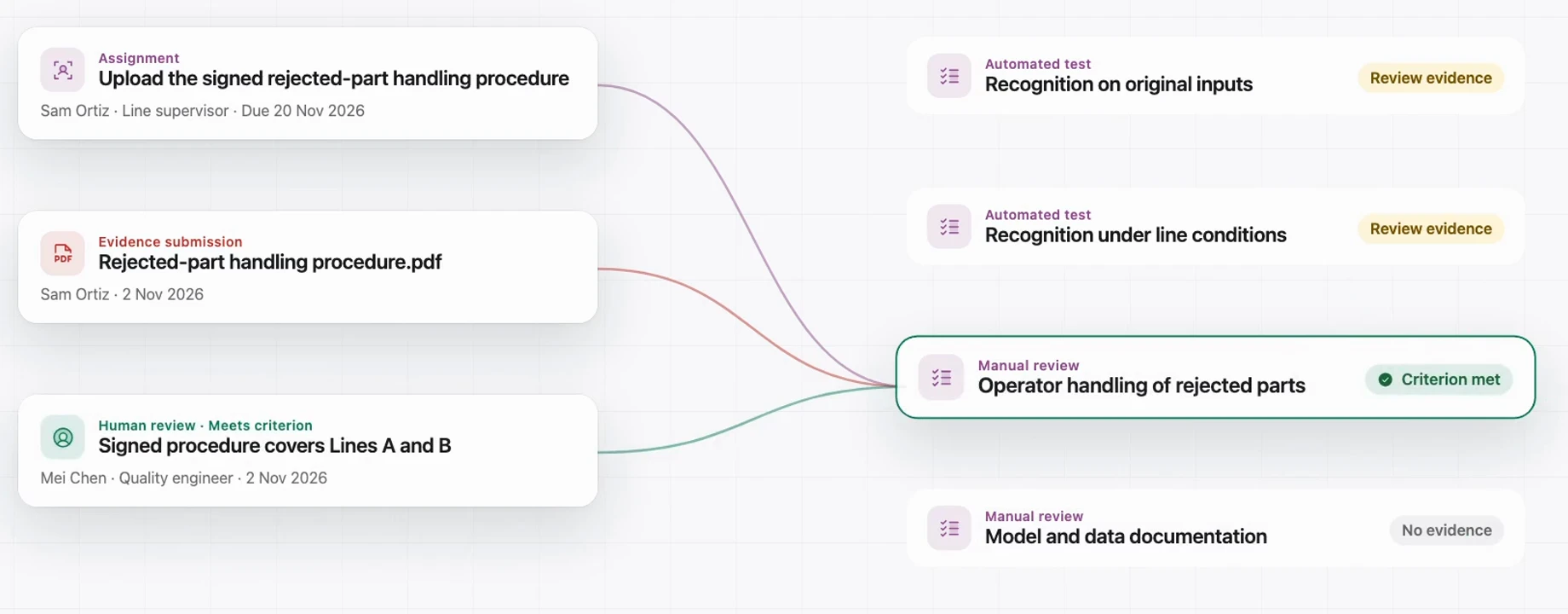
New version. A new decision, with the history intact.
When the system’s components or configuration change, start a follow-on Assessment. Carry useful context forward, reopen work that depends on the new version, and decide which earlier evidence still applies. The previous decision keeps its own record.
Explore reassessmentFrom one assessment to the next
Carry context forward
Review the scope, standards, plan and evidence links you want to retain.
Reopen affected work
Gather and review evidence for the changed configuration.
Record the next decision
Keep its results and conditions alongside the earlier decision’s history.
Standards and methods, ready to explore.
Explore what each standard asks you to prepare and what each testing method can tell you.
EU AI Act
Provider and deployer evidence for the provisions that apply to your role and risk level, with the Annex IV technical documentation and instructions for use assembled from it.
NIST AI RMF 1.0
A review organised around Govern, Map, Measure and Manage, and an AI RMF profile.
NYC Local Law 144
The bias audit data, published results and candidate notices for automated hiring tools.
ISO/IEC 42001
An AI management system, usually run once for the organisation and inherited by each product Assessment.
Data quality
Find gaps, errors and leaks in the data before they reach the model.
Performance
Measure how well the model does its task on your own data.
Robustness
Make conditions harder, then measure the relative drop in performance.
Fairness
Compare results across groups to find what an average can hide.
Explainability
See which inputs drive a prediction, and check that the explanation holds up.
Put evaluation into practice.
Explore practitioner guides, use cases and learning paths in the docs.
Practitioner guides
Start a project, prepare your inputs and review the evidence.
Standards catalog
Review the scope and preparation guidance for each standard.
Testing methods
Find checks for data quality, performance, robustness, fairness and explainability.
Questions, answered.
What is Knotest?
Knotest is HephaKnot’s AI evaluation platform for teams building or buying AI. It connects the intended use, data checks, model tests, risks and evidence so reviewers can understand the basis for a decision.
How can I get access?
Join the waitlist with your email address. You can also share what you need by replying to the confirmation email.
What can I explore in the walkthrough?
Follow the evaluation workflow from organizing data and setting test conditions to comparing model results, tracking risks and retaining evidence.
Does Knotest certify compliance?
Knotest helps you prepare and retain evidence. Audits, certification and legal conclusions stay with your auditors, accredited bodies and counsel.
Where can I explore standards and methods?
The catalog lists standards and testing methods. Each entry explains its scope. If something you need is missing, tell us when you join the waitlist.
Bring your next AI evaluation to Knotest.
Join the waitlist to connect your tests, evidence and decisions in one workspace.